The Condition of Spelling “Eternity”
The Snow QueenThe Condition of Spelling Eternity is the Snow Queen’s test for Kay: if he can arrange pieces of ice into the required word, he will become his own master and receive the whole world and a new pair of skates. The condition turns a game of icy shapes into a measure of captivity and release. Kay struggles to satisfy it while the Snow Queen is away, but the word appears only after Gerda reaches him, the splinter leaves his eye, and they are reunited.
The Puzzle and Its Setting
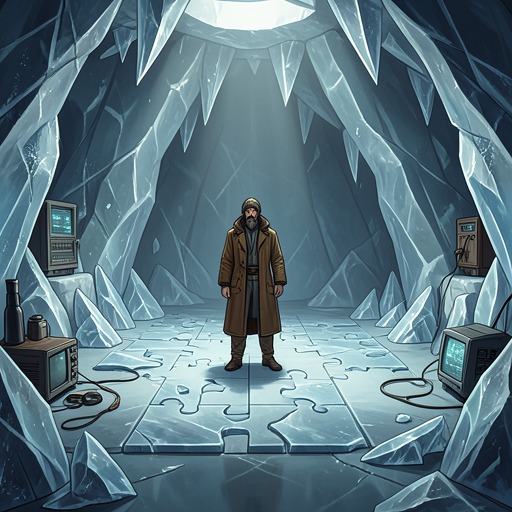
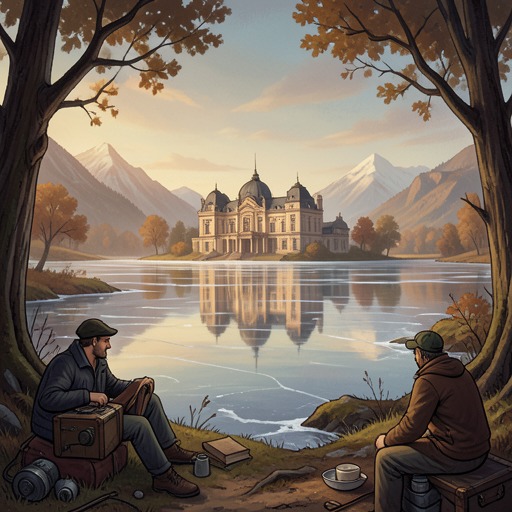
The task takes place in the vast central hall of the Snow Queen’s palace, where she sits beside a frozen lake she calls the Mirror of Reason. Its surface is broken into a thousand forms, each piece resembling another and each perfect in itself, as though the ice were an artful system waiting to be read. Kay drags sharp, flat pieces across the floor and fits them together in changing arrangements. The physical act resembles making pictures from small wooden tablets, but here the pieces belong to the Queen’s frozen domain and their arrangement carries a condition of freedom.
The required word is Eternity. The Queen makes the terms explicit: once Kay finds it, he will be his own master, and she will give him the whole world and a new pair of skates. Her offer joins a promise of independence to an extravagant reward, yet it also defines the limit of Kay’s present power. He can manipulate the pieces and form complete figures and other words, but the one arrangement that would change his status remains beyond him. The account gives no deadline; the test holds him through his inability to finish it, not through a stated time limit.
Kay’s Failure to Complete the Word
Kay’s failure is tied to the changes that have already taken hold of him. He is blue with cold, almost black, but does not feel the cold because the Snow Queen has kissed away his shivering and his heart has become a lump of ice. A splinter of glass remains in his eye. Under its influence, the figures he makes seem remarkably important and highly accomplished, while the word he most wants to form continues to elude him. His skill at arranging shapes therefore does not amount to freedom: he can complete many patterns, but cannot reach the one pattern named by the Queen’s condition.
When the Snow Queen leaves for warmer countries, she leaves Kay alone in the enormous hall. He remains seated with the ice pieces, thinking so deeply and so still that he might be taken for frozen. The scene holds the condition in suspension: the promised reward is available in principle, but Kay’s attention and abilities are confined to the puzzle that he cannot solve. His isolation makes the test more than a clever arrangement of letters; it is the form taken by his continued separation from ordinary warmth and companionship.
The Word Appears
Gerda’s arrival changes the scene before the puzzle is completed. She recognizes Kay, embraces him, and speaks to him with joy at having found him. As she recites the verse about roses blooming and passing away and seeing the Christ-child, Kay bursts into tears. The splinter of glass swims out of his eye. He recognizes Gerda, looks around at the cold, empty hall, and clings to her. The account thus places the breaking of the spell’s visible bodily sign and the recovery of recognition before the word is made.
After the children lie down, the pieces of ice dance about and then arrange themselves into the letters of Eternity. Kay has not managed to assemble the word through his solitary efforts; it takes shape in the moment of reunion, after Gerda’s presence has brought him to tears and the glass has left his eye. The narrative does not describe the pieces as a conscious decision by Kay, nor does it specify a mechanical explanation for their movement. It presents the completed word as the decisive result of the changed scene: the arrangement he could not make alone is now visible in shining ice letters.
Freedom and the Condition’s Significance
The word’s appearance converts the Queen’s promise into a certainty. The narration says that the Snow Queen may come home whenever she pleases, because Kay’s freedom now stands written in the letters she required. The test is therefore fulfilled even though Kay did not complete it by himself. Its ending links the puzzle’s formal requirement to the restoration of a relationship: the condition concerns Kay’s ability to arrange ice, while its resolution follows Gerda’s arrival, his tears, and his recognition of her.
The episode also complicates the Queen’s claim to govern Kay through a test of reason. The frozen lake is her Mirror of Reason, and Kay’s work with its pieces appears to him as the highest kind of achievement; still, his isolated skill cannot free him. The decisive sequence is not another intellectual attempt, but an embrace, tears, and recognition, followed by the word’s formation. The story does not cancel the Queen’s stated condition: Eternity is indeed spelled, and its appearance marks Kay’s release. But the circumstances make the fulfilment inseparable from the recovery of feeling and connection that had been absent during his solitary work. After the letters have formed, Gerda kisses Kay’s cheeks, eyes, hands, and feet; he becomes healthy and cheerful, and they leave the palace together. The promised word thus marks not merely the end of a puzzle, but the point at which the puzzle’s power over Kay gives way.